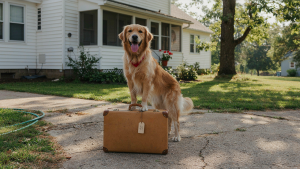
Few things tug at the heartstrings like a dog watching the suitcase come out of the cupboard. Do you pack the lead and take them along, or arrange a stay while you’re away? The answer usually comes down to your dog’s temperament and the trip itself, not to guilt. This guide walks through the decision-making process using the approach of Kodiak K9, an in-home dog board-and-train service founded by police K9 handlers. It matters to many households, too: Animal Medicines Australia’s 2025 report found that 49% of Australian households have at least one dog.
Why leaving your dog behind feels so hard
Dogs are family, so leaving one at home can feel like a small betrayal. That guilt is common, and it’s often misplaced. A dog who is stressed by a long drive, a strange room, and a day of new noises isn’t having a better time just because you’re nearby. Sometimes staying behind in calm, well-run care is the kinder choice.
Is your dog a travel buddy or a homebody?
Signs your dog suits travel
Travel-ready dogs settle quickly in new places, walk calmly on the lead around distractions, and cope with car rides without panting, drooling, or whining. They greet strangers and other dogs politely and can nap anywhere, which is a real talent.
Signs your dog may be happier at home
Dogs who are anxious, reactive, or prone to heavy barking in new spaces often find travel exhausting. The same goes for dogs who struggle with long or hot journeys, or who simply can’t switch off in an unfamiliar room.
What are the best holidays to take with a dog?
The best dog holidays are relaxed and flexible: beach or coastal stays with dog-friendly stretches, cabins and farm stays, and slow road trips with regular stops. The common thread is downtime. Dogs cope best when the itinerary leaves room to walk, sniff, and nap.
One safety point is non-negotiable. Never leave a dog in a parked car. Dogtopia’s travel guide notes that on an 85°F day (about 29°C), the inside of a car can reach 104°F (about 40°C) in just ten minutes.
When your dog can’t come along
Some trips just aren’t dog-friendly. Events, restricted parks and beaches, flights, and venues with strict rules can all rule your dog out. In those cases, arranging care in advance is safer and calmer for everyone.
Do dogs enjoy being boarded?
It depends on the dog and the setup. A sociable, adaptable dog may treat a stay like summer camp. A nervous dog can find a busy kennel overwhelming. The Animal Humane Society suggests a pet sitter for animals with separation anxiety or trouble adapting to new spaces, and a boarding facility for dogs who adjust quickly. Home-style care sits in the middle: a calm household, fewer dogs, and more one-on-one attention.
What is the 3-3-3 rule with dogs?
The 3-3-3 rule is a guideline for newly adopted dogs. It suggests about three days to decompress, three weeks to learn the routine, and three months to feel truly at home. It wasn’t written for boarding, but the idea carries over: any new environment takes a dog time to absorb. That’s why a short trial stay before a big trip helps, and why a stay of a couple of weeks gives a dog room to move past the nerves and settle in.
What is the 7 7 7 rule for dogs?
The 7-7-7 rule is a popular puppy socialization rule of thumb. Versions vary, but the gist is to expose a young puppy to seven different people, places, surfaces, objects, sounds, and challenges. It’s a guideline rather than a scientific standard, yet the principle holds up. Dogs who encounter a wide variety of early tend to handle change better later. Adult dogs who missed out can still build confidence through structured dog training.
Kennels, sitters and board and train: how they compare
- Kennels and boarding facilities: structure, supervision, and social play, but a busier environment and less individual attention.
- Pet sitters: familiar routines and one-on-one care, but everything depends on one person, and there’s little structured learning.
- Home-style board and train: a family-home setting, daily structure, and training built into the stay.
How a dog board and train stay works
A dog board-and-train program is a stay that doubles as training. At Kodiak K9, dogs live in a trainer’s home rather than in a kennel for about two to three weeks. They practice obedience, household manners, and impulse control throughout the day, including outings to parks and shops. Owners receive daily photos and updates, and the session concludes with a lesson on maintaining progress at home.
Here’s a real-world example. One family reported that their six-year-old dog went from pulling and lunging at other dogs to walking calmly after a two-week stay. The reasoning is simple. Constant daily practice with a professional dog trainer builds habits faster than an hour-long class once a week.
Limitations to weigh
- It’s a longer time and money commitment than a weekend sitter.
- It isn’t suited to a one or two-night trip.
- Results still depend on you keeping up the routine at home.
- Places are limited, so booking early matters.
Questions to ask any dog trainer or boarding provider
- What experience do the trainers have?
- Will my dog live in a home or a kennel, and who supervises them overnight?
- How often will I get updates, and in what form?
- What happens if my dog is unwell or unsettled?
- How does the handover work when I collect my dog?
- Can I meet the trainer first?
How to prepare your dog for time away
- Book a short trial stay before the main trip.
- Pack familiar comforts such as a bed, a favorite toy, or an unwashed T-shirt.
- Keep feeding and walking routines steady in the lead-up.
- Check that vaccinations are up to date.
- Write a short note on your dog’s routine, triggers, and health.
- Keep goodbyes calm and brief.
A quick way to decide
- Take your dog along if they’re calm and adaptable, the destination is dog-friendly, and the journey and weather are safe.
- Arrange care if your dog is anxious or reactive, the trip involves long travel, heat or events, or the accommodation doesn’t allow pets.
- Consider board and train if you’d like time away to double as training.
The right choice is the one that suits your dog
There’s no prize for the option that looks most devoted. A relaxed, well-cared-for dog is a better holiday memory than a stressed one in every photo. So when the next trip comes up, ask yourself: is my dog’s happiest holiday the one beside me, or the one where they’re calm, safe, and a little better behaved when I get home?